Malaysia tabled Budget 2027 on 9 October 2026, targeting continued fiscal consolidation while supporting household spending and investment. The Ministry of Finance (MoF) projects the fiscal deficit to narrow to 3.6% of gross domestic product (GDP) in 2026 (2025: 3.7%) and 3.3% in 2027, moving towards 3.0% by 2028. In absolute terms, however, the deficit is projected to decline only marginally by about RM1.0 billion, to RM77.5 billion in 2027 (2026: RM78.5 billion). Thus, much of the improvement in the deficit-to-GDP ratio reflects nominal GDP expansion rather than a reduction in the deficit. This suggests that the favourable effect on the fiscal deficit may fade as growth normalises in the future.
The MoF raised its 2026 real GDP growth forecast to 4.8%–5.3% (Budget 2026: 4.0%–4.5%) and projects growth of 4.2%–5.2% in 2027. Domestic demand remains the main anchor, supported by government transfers to households, alongside a higher minimum wage in 2027. Furthermore, investment will continue in higher-value and high-impact sectors, including semiconductors, digital technology, logistics and energy transition. Approved investments rose 11.7% y-o-y to RM218.5 billion in the first half of 2026, while gross exports surged 31.2% to RM1.4 trillion in the first eight months of 2026. This export strength, however, remains vulnerable to volatility in external demand and trade policy; Budget 2027 supports growth stability through enhanced small and medium enterprise (SME) financing and export diversification, deepening local firms’ participation in these value chains. Meanwhile, headline inflation is projected to rise slightly to 1.8%–2.8% in 2027 (2026: 1.5%–2.5%), potentially peaking in early 2027 following the pass-through of higher energy, food and other input costs before easing in the second half.
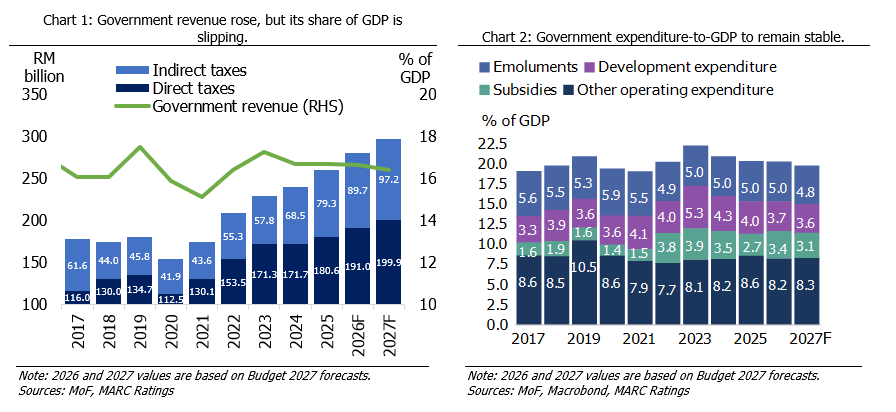
Total revenue is projected to rise 4.7% to RM380.8 billion in 2027 (2026: RM363.6 billion, +8.1% y-o-y), while its share of GDP is expected to decline to 16.4% from 16.6%. Tax revenue is projected to grow 5.8% to RM297.1 billion in 2027, equivalent to 78% of total receipts and 12.8% of GDP, split between RM199.9 billion (2026: RM191.0 billion) in direct and RM97.2 billion (2026: RM89.7 billion) in indirect taxes. Non-tax revenue (licences, permits, and investment income) is forecast to increase by 1.1% to RM83.7 billion in 2027 (2026: RM82.9 billion), or 3.6% of GDP (2026: 3.8%). Revenue measures centre on the full implementation of e-invoicing, digital self-assessment for stamp duty, as well as stronger audits and enforcement. These are partly offset by reduced personal and micro, small and medium enterprise (MSME) income tax rates, and expanded personal tax reliefs and deductions. As such, the tax base has scope to improve over the medium term.
Petroleum-related revenue is projected at RM61.2 billion in 2027, or 16.1% of total revenue, lifted by a larger dividend of RM32 billion (2026: RM27 billion) from Petroliam Nasional Berhad (PETRONAS). Other expected investment income will also be supported by institutions such as Bank Negara Malaysia and Khazanah Nasional Berhad.
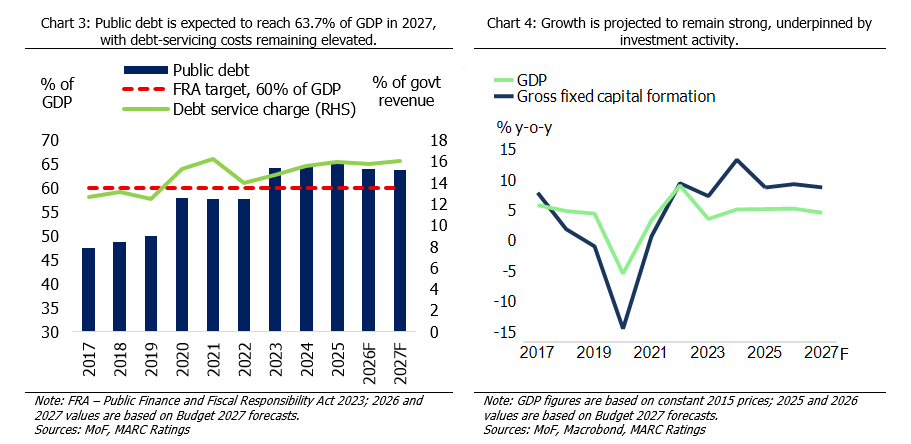
Total expenditure in the Budget continued to increase to RM459.8 billion (2026: RM444.1 billion; 2025: RM412.7 billion). While the 3.6% y-o-y rise in total expenditure under Budget 2027 appears modest, it follows an increase of 5.9% in the original allocation under Budget 2026. The 2027 total comprises RM376.8 billion in operating expenditure (+3.8% y-o-y; 81.9% of total expenditure) and RM83.0 billion in development expenditure (+2.5% y-o-y; 18.1% of total expenditure; 13th Malaysia Plan average: RM86 billion per year). Consequently, the growth of development expenditure lags operating expenditure. However, the government has mobilised an additional RM50.2 billion in non-federal funds (2026: RM50.8 billion), including government-linked investment companies, public-private partnerships and federal government statutory bodies’ investments.
The 2026 revision reflects heavier fuel subsidies under an average oil price assumption of USD85 per barrel (Budget 2026: USD60–USD65 per barrel), which raised subsidies and social assistance by 52% to RM74.5 billion from RM49.0 billion under Budget 2026. The 2027 allocation has moderated to RM72.7 billion, although it remains substantially above the RM55.3 billion level recorded in 2025. Fuel subsidies are expected to remain around RM40 billion, while Sumbangan Tunai Rahmah (STR)/ Sumbangan Asas Rahmah (SARA) has risen to RM16 billion from RM15 billion.
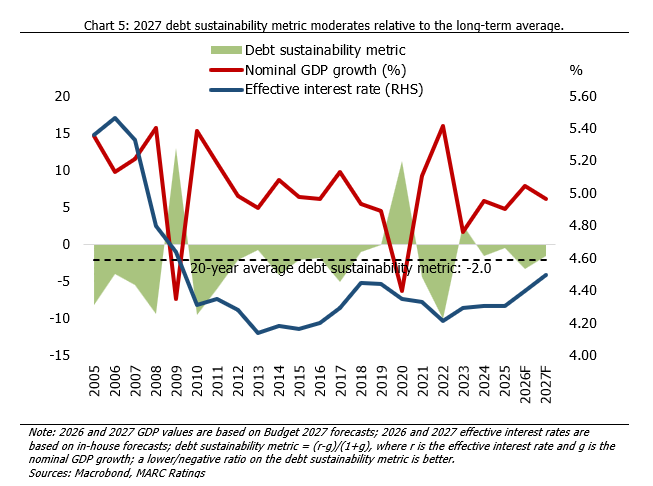
Federal Government debt-to-GDP is forecast to decline from 65.2% in 2025 to 64.0% in 2026 and 63.7% in 2027. Debt dynamics remain manageable, with nominal GDP growth continuing to exceed the effective interest rate on government debt. However, debt sustainability is projected to moderate in 2027 amid rising funding costs as global inflation, interest rates, and yields rise (see Chart 5). Contingent exposures remain material, as financial guarantees stood at RM446.3 billion, equivalent to about 22% of GDP, as at end-2025, slightly below the 25% ceiling under the Public Finance and Fiscal Responsibility Act 2023. Furthermore, Budget 2027 also raises overall loan and financing-guarantee facilities for MSMEs to RM57 billion from RM50 billion. The nation’s debt service charges are also rising in 2027, absorbing about 16% of revenue.
Overall, Budget 2027 charts a gradual fiscal consolidation path, although fiscal flexibility has room to improve as operating expenditure accounts for nearly 82% of total expenditure, a rising trend from 76.4% as of 2023. Meanwhile, elevated energy prices and the risk of increasing funding costs could further complicate the pathway towards optimising public finances. The Budget seeks to support domestic demand while preserving fiscal sustainability, with medium-term outcomes increasingly dependent on revenue mobilisation, subsidy rationalisation and productivity gains from public investment.